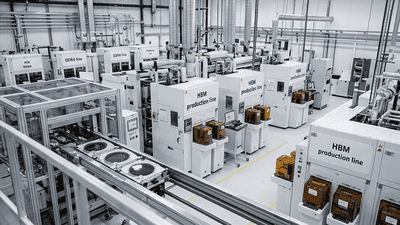
Hybrid bonding—a suite of direct copper-to-copper and copper-to-dielectric bonding techniques—has become central to the HBM4 roadmap. Where previous HBM generations relied primarily on micro-bumps and through-silicon vias (TSVs), HBM4 pushes signaling density and electrical performance to levels that make hybrid bonding not optional but essential.

Why hybrid bonding is critical for HBM4
HBM4 targets higher per-pin data rates, increased per-die capacity, and tighter power-performance envelopes compared with HBM3E. Hybrid bonding addresses several hard limits that micro-bumps and legacy bonding approaches encounter at these targets:
- Electrical performance: Hybrid bonds reduce parasitic inductance and capacitance compared with micro-bumps, enabling higher signaling rates and improved signal integrity across very fine pitches.
- Pitch scaling: Hybrid bonding supports much finer interconnect pitches (sub-µm to low-µm regimes) which increases the number of channels and data lanes available in the same footprint.
- Mechanical and thermal continuity: Direct metal bonding offers better mechanical rigidity and can provide lower thermal boundary resistance when combined with thermally conductive, electrically insulating films.
- Yield potential: While hybrid bonding initially has a steep yield-learning curve, once mature it reduces certain classes of mechanical failure modes associated with micro-bumps, such as solder fatigue in high-cycle thermal environments.
These advantages are why HBM4 packages increasingly design bonding planes with hybrid interfaces between die-to-die and die-to-interposer, especially where high-density signaling and low latency are most critical.
Phases of hybrid bonding adoption

Adoption of hybrid bonding across the HBM4 supply chain follows a multi-year progression. Each phase presents distinct opportunities and risks:
- Phase 1 — Pilot and co-development (2023–2025): Early adopters validate hybrid processes on small form factors, tooling vendors prototype alignment and bonding systems, and materials suppliers qualify thin dielectrics and temporary bonding films. Volumes are limited and customers are primarily strategic hyperscalers and OEMs willing to co-pay for development risk.
- Phase 2 — Early production and yield ramp (2025–2027): Hybrid bonding moves into early production for HBM4 pilots and selective high-performance products. OSATs expand process windows; equipment suppliers ship production-grade tools; interposer and wafer-level process flows adjust for hybrid-bond cleaning and planarization steps. Yields improve but packaging capacity remains constrained.
- Phase 3 — Volume scale and cost optimization (2027+): Hybrid bonding becomes the dominant bonding method for high-end HBM4 stacks and is optimized for throughput, cycle time, and cost. Standardized materials and test flows reduce variability, and second-tier OSATs enter the market as process knowledge diffuses.
Each phase widens the addressable market for different supply-chain players; early phases favor engineering partnerships, while later phases reward scale and throughput efficiency.
Equipment and tooling opportunities
Hybrid bonding adoption drives a significant shift in capital equipment needs. Key tooling categories and the supply-chain implications include:
- High-precision alignment and bonding platforms: Systems capable of sub-100 nm alignment at high throughput are fundamental. Equipment vendors that can pair micron-scale alignment with fast cycle times capture the lion’s share of OSAT capex budgets.
- Wafer/die cleaning and surface-activation tools: Hybrid bonding requires ultra-clean, activated surfaces. Chemical treatments, plasma activation stations, and high-precision metrology for surface roughness and contamination control are in higher demand.
- Planarization and chemical-mechanical polishing (CMP): As hybrid bonds require exceptionally flat surfaces, CMP equipment with fine-control capability benefits from increased installations in IDMs and OSATs focused on HBM4.
- Metrology and inline inspection: Defect detection at bonding interfaces, void mapping, and non-destructive layer integrity inspection are critical. Vendors providing automated optical and X-ray inspection systems tailored to hybrid-bond interfaces will see increased demand.
- Thermal and pressure-control bonding modules: Tight control of bonding temperature, pressure profiles, and atmosphere (e.g., inert environments) is required; modular systems that integrate with existing pick-and-place lines have an advantage for faster adoption.
Vendors that can offer integrated tool chains and service contracts to accelerate customer yield learning will capture higher lifetime value than those selling discrete point tools alone.
OSAT and IDM strategies

Hybrid bonding shifts value toward vendors that combine process capability, yield engineering, and systems integration. OSATs and integrated device manufacturers (IDMs) must consider several strategic moves:
- Invest in clean-room and bonding-capable lines: Converting or building lines with hybrid-bond tooling requires capital and specialized process control. OSATs that invest early secure anchor customers in the ramp phase.
- Develop hybrid-bond IP and process recipes: Proprietary cleaning, activation, and bonding recipes reduce yield variance; OSATs that develop differentiated process IP can charge premiums and protect margins.
- Partner with equipment vendors: Co-development partnerships to customize tools for specific HBM4 use cases speed qualification and reduce time-to-volume.
- Offer turn-key module services: Beyond bonding, offering integrated services—die thinning, RDL, underfill, testing, and thermal integration—simplifies procurement for memory manufacturers and OEMs, creating stickier relationships.
High-end IDMs with in-house packaging (for example, large memory vendors) may retain more of the value chain; however, many OEMs will rely on specialized OSAT partners to scale capacity cost-effectively.
Materials and consumables market
Hybrid bonding adoption expands demand for specialized materials. Materials suppliers can expect growth across several product categories:
- Ultra-thin dielectrics and low-k barrier films: These materials facilitate fine-pitch bonding while controlling capacitance and leakage at high frequency.
- Adhesives and temporary bonding films: High-temperature-stable temporary bond films enable back-grinding and handling during thin-die processing; suppliers that offer low-outgassing, thermally robust films will be favored.
- Surface-activation chemistries: Plasma chemistries and wet-clean agents formulated to activate copper or patterned dielectric surfaces without leaving residues are critical consumables.
- Advanced underfills and thermally conductive films: Materials that combine electrical insulation with high thermal conductivity help manage heat across bonded interfaces in HBM4 stacks.
- Precision fluxless bonding materials: As many hybrid-bond processes avoid solder flux, alternative fluxless chemistries and process aids are a niche opportunity.
High-volume consumables with strict contamination-control profiles can become recurring revenue streams for materials vendors once supply contracts are established.
Interposer and substrate implications

Hybrid bonding increases the density and complexity of interposer routing and influences substrate design. Implications for interposer and substrate suppliers include:
- Tighter integration with hybrid-bond pads: Interposers must accommodate fine-pitch bond pads and delicate planarization specs, increasing manufacturing difficulty and creating a premium for advanced interposer fabs.
- Embedded passive and active elements: With hybrid bonding offloading some electrical needs, interposers increasingly embed decoupling capacitors, power distribution meshes, and local signal conditioning—benefit accrues to advanced interposer fabs capable of heterogeneous integration.
- Substrate redesign: System substrates must route higher-speed lanes and often integrate thermal pathways for microfluidic or active cooling; substrate makers with high-layer-count, low-loss laminates will be advantaged.
- Supply concentration: Large-area, high-quality interposer supply is limited; firms able to expand capacity or partner globally will capture disproportionate market share in the early HBM4 ramps.
Interposer suppliers that invest in process control for large-area silicon and offer design-rule kits for hybrid-bond integration become strategic partners for HBM4 module makers.
Test, inspection, and reliability opportunities
Hybrid bonds introduce new failure modes and testability challenges. This creates a market for specialized test and reliability services:
- Non-destructive interface inspection: X-ray tomography, scanning acoustic microscopy (SAM), and novel optical techniques that identify voids and bonding defects at scale are essential.
- High-frequency electrical test: Test equipment that can validate bond-channel performance at near-operating speeds helps catch marginal bonds before final assembly.
- Thermo-mechanical stress testing: Accelerated thermal cycling and shock tests tailored to hybrid-bond interface behavior are needed to qualify materials and process windows.
- Failure-analysis services: When defects occur, rapid root-cause analysis that correlates process parameters, metrology data, and end-of-line failures shortens yield learning loops.
Testing and reliability vendors creating turnkey qualification suites for hybrid-bond HBM4 assemblies will find recurring demand from both IDMs and OSATs.
System integrator and OEM impacts
For OEMs and system integrators, hybrid-bond HBM4 modules change procurement and system design practices:
- Design rules and co-qualification: OEMs must co-qualify packages and thermal solutions early in the design cycle to ensure system-level interoperability and reliability.
- Supplier consolidation vs. diversification: Given early supply constraints and high integration complexity, many OEMs choose a small set of strategic suppliers while maintaining secondary qualifications to manage supply risk.
- Value beyond die: With hybrid bonding, much of the system value shifts into packaging and integration. OEMs that embrace co-investment or vertical partnerships can secure prioritized access and cut total cost of ownership.
- Service and field support: Because hybrid-bond packages can interact with cooling and power infrastructures in new ways, OEMs must plan for new service models, diagnostics, and field-replaceable units tailored to packaged modules.
Early adopters that invest in supplier partnerships and integration playbooks gain faster time-to-market and more predictable performance scaling.
Financial and market signals to watch
Certain announcements and metrics indicate whether hybrid bonding adoption for HBM4 is progressing healthily and which suppliers will benefit:
- Capex plans from leading OSATs and IDMs for hybrid-bond tooling—publicized investments signal where packaging capacity will expand.
- Long-term supply contracts and co-investment agreements between hyperscalers/OEMs and suppliers—these de-risk large capital projects and secure early volumes.
- Yield improvement reports and process-transfer success stories—companies publishing meaningful yield gains justify valuation premia for packaging and equipment vendors.
- Cross-industry standardization efforts—agreements on pad pitches, cleaning chemistries, and test flows accelerate adoption and lower integration friction.
Investors and procurement teams should monitor these signals to identify which nodes of the supply chain are de-risked and likely to lead revenue growth as HBM4 ramps.
Risks and bottlenecks
Despite its advantages, hybrid bonding introduces risks and concentrated bottlenecks that the supply chain must manage:
- Yield volatility during ramp: Early production can experience high scrap rates due to particulate contamination, alignment drift, or surface-activation variability.
- Equipment lead times: Tooling for hybrid bonding and associated metrology can have long delivery lead times, creating short-term capacity constraints.
- Material qualification cycles: New dielectrics, adhesives, and activation chemistries require lengthy qualification to meet reliability standards for memory modules.
- Concentration of expertise: A small number of OSATs, interposer fabs, and equipment vendors possess hybrid-bond manufacturing expertise—this concentration creates single points of failure and pricing power.
Mitigation strategies include multi-year supplier contracts, co-investment to expand qualified capacity, and investment in contamination-control and process-monitoring systems to accelerate yield maturation.
Strategic recommendations by stakeholder
To capitalize on hybrid bonding adoption in HBM4, different players should pursue targeted actions:
- Equipment vendors: Focus on integrated tool chains, service contracts, and co-development with OSATs to shorten time-to-yield. Offer flexible modules that scale from pilot to volume without full line rebuilds.
- Materials suppliers: Prioritize low-contamination, thermally robust consumables and partner with IDMs/OSATs for fast-track qualification. Offer application engineering support as part of the product package.
- OSATs and interposer fabs: Invest in pilot lines, yield-engineering teams, and inspection infrastructure. Build partnerships with customers for co-funded capacity expansion and provide turn-key integration services.
- Memory manufacturers and IDMs: Protect long-term supply through co-investment and strategic partnerships; retain IP on bonding recipes where it creates defensible yield advantage.
- OEMs and hyperscalers: Lock in long-term supply agreements with hybrid-bond-capable suppliers, co-design thermal and mechanical interfaces early, and consider co-funding capacity where justified by volume.
Longer-term outlook
Hybrid bonding will likely become the default for high-end HBM4 packages and broader heterogeneous integration use cases as throughput increases and toolsets mature. Over the next 3–5 years expect:
- Standardization of hybrid-bond pitches, cleaning protocols, and test methodologies, lowering integration friction and enabling second-tier players to enter the market.
- Diffusion of hybrid-bond techniques into other markets—AI accelerator chiplets, advanced logic stacking, and photonics integration—expanding the equipment and materials TAM beyond HBM4.
- Cost reductions driven by higher tool throughput, improved yields, and more competitive OSAT offerings, making hybrid-bond packages accessible beyond the highest-end segments.
- A growing services market for yield acceleration, failure analysis, and retrofit/test systems that support continued margin capture across the supply chain.
These trends will change where margin is captured across the stack: early winners will be equipment and materials vendors that enabled yield improvements and OSATs that demonstrated reliable, repeatable processes at scale.
Conclusion
Hybrid bonding adoption is a foundational enabler of HBM4’s performance objectives. While initial ramps are capital- and expertise-intensive, the technology unlocks dramatic improvements in signaling density, latency, and power efficiency that micro-bump approaches cannot realistically match at HBM4 targets. The transition creates a broad set of supply-chain opportunities: high-precision equipment and metrology vendors, specialized materials suppliers, OSATs and interposer fabs that build hybrid-bond expertise, and service providers that accelerate yield learning and qualification.
For investors and supply-chain planners, the smart play is to identify nodes where process knowledge and equipment lead times create durable advantages. For OEMs and hyperscalers, early engagement, long-term contracts, and co-investments will be the most reliable ways to secure prioritized access as hybrid bonding scales across HBM4 production.